CCL published the second annual State of New Zealand Cloud Transformation Report in late August. Four key themes are explored (and in color-coded sections, too) – cloud adoption, cloud models, cloud operations, and emerging technology.
Headline findings from our POV:
- Cloud adoption – cloud platforms are increasingly important to NZ organizations, driven by cost reduction and efficiency goals. Self-assessed maturity with cloud adoption has regressed year-on-year.
- Cloud models – private and public clouds are the dominant model today, but this will be supplanted by hybrid cloud and multi-cloud (at least two disparate clouds) in the future. This trend is driven by flexibility and scalability and disaster recovery / failover between clouds.
- Cloud operations – 88% of NZ firms plan to maintain or increase use of managed service providers. Dominant cloud workloads are collaboration and productivity (52% fully in the cloud, 25% partially in the cloud) plus storage and backup (50% fully, 30% partially). The greatest uncertainty on workloads in the cloud is core business e.g., manufacturing or supply-chain (16% combined for don’t know or won’t move to the cloud) and development and testing (also 16% combined).
- Emerging technology – organizations are most likely to have adopted several types of emerging technologies – #1 = data sets or data analytics, #2 = IoT, #3 = AI, and #4 = low code / no code technologies. The adoption maturity profile is different than the adoption pattern, however: #1 = low code / no code, #2 = data sets or data analytics, #3 = virtual reality / augmented reality, and #4 IoT. ML and AI in second-to-last and last places respectively in the list of 8 options.
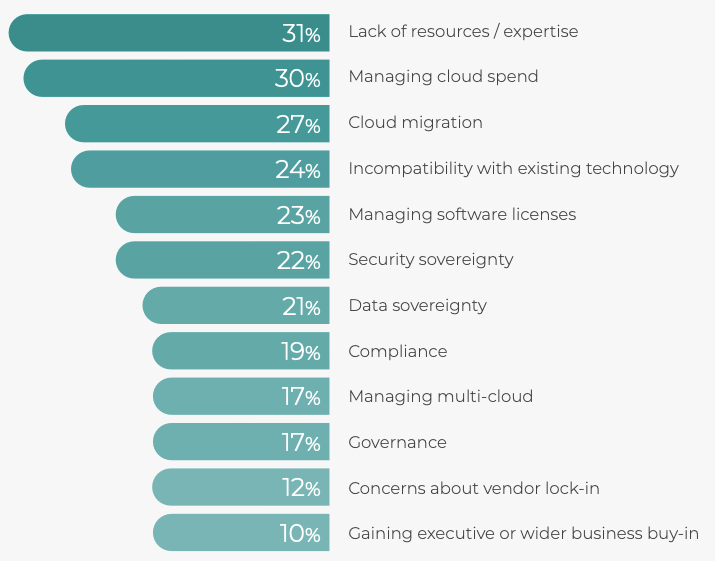
In the cloud adoption section, the following diagram shows the challenges faced with adopting or managing cloud (see page 11 in the report):
If we look at the non-challenges side of how respondents answered the question, then we’d say this about adopting and managing cloud in NZ by NZ organizations:
- 90% have been able to gain executive or wider business buy-in – and since the key adoption driver is saving money and cost efficiency, that’s not hard to see why.
- 88% don’t have concerns about vendor lock-in.
- 83% don’t find cloud governance to be a concern.
- 83% can manage multi-cloud with the tools they have available.
- 81% are fine with compliance posture, 79% with data sovereignty posture, and 78% with security posture.
- The area that NZ organizations struggle with the most – 69% are okay but 31% are struggling – is with lack of resources and expertise.
And based on those numbers, we’d say:
- Good progress is being / has been made.
- The move to a more complex setup (hybrid multi-cloud) is going to have the biggest effect for amplifying the challenge of resourcing and expertise, particularly where re-platforming, re-developing, and re-factoring are the chosen approaches versus switching to cloud-based solutions (“re-placing”) or lift-and-shift strategies (“re-hosting”) – per comments on page 21 of the report.
For more, request a copy from CCL.
Leave a Reply